
What dead people?
The government's atrocious use of data is a core reason people don't trust it

Elon Musk was outraged. Soon after he arrived in Washington, pledging to root out two trillion dollars in fraud, waste, and abuse, someone told him that the Social Security Administration (SSA) was paying millions and millions of dead people. He immediately took to X to tweet memes and exaggerations. “Maybe Twilight is real and there are a lot of vampires collecting Social Security,” quipped Musk in one of his many tweets on the topic.
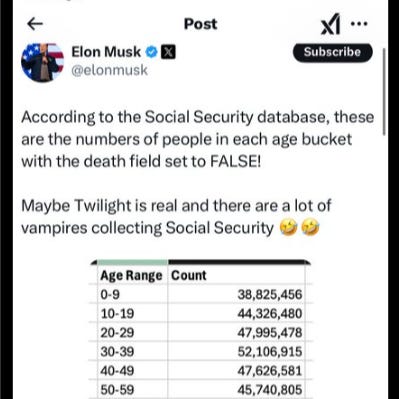
Now, to fact-check, the real figure is not millions and millions, but about 89,000. 89,000 people aged 99 or older actually received benefits from Social Security in 2024. So why was Elon Musk told the number was an order of magnitude higher? Well, that mystery became the topic of several social media news cycles during which the Internet hypothesized about the causes of the alarming figure and then eviscerated the hypothesizers. Some posited that the culprit was the COBOL programming language Social Security uses. Specially, that it defaults to an “epoch” date of May 20, 1875, making anyone who’s birthday was unknown default to being 150 years old in 2025. But that was quickly debunked by COBAL experts deriding the theory in profanity-laced tweets and blogs as bullshit, stating that COBOL does not, in fact, have a default epoch date.
The real story is less sexy. As the SSA Inspector General (IG) reported in 2023, Social Security officials have mostly been lazy about updating death data for really old people, since they are no longer alive, they are not getting any benefits, and they didn’t think cleaning up this data was a priority (note that SSA automatically stops paying anyone whose birthdate makes them aged 115 or older). The IG found about 19 million people who have dates of birth in 1920 or earlier but no corresponding death information on their Social Security record. The IG told SSA they should update the data, so it is accurate, which is more important today given the rise of criminals monetizing stolen identities, but they mostly didn’t (they added death dates to about 1 in 6 records in which the auditors found were missing the information), citing resource constraints. The fact that people born before 1920 have no corresponding death dates in the database does not mean they are receiving social security benefits. It means SSA is very bad a record keeping and its data is unreliable.
On May 23, 2025, DOGE announced that it had finished this “major cleanup initiative: ~12.3M individuals aged 120+ have now been marked deceased.” As the Washington Post fact-checker pointed out, the post was carefully worded. It did not claim that 12 million people had received benefit payments, just that they had been marked deceased. Essentially, DOGE implemented the SSA IG’s recommendation.
Michelle Anderson, SSA’s acting IG, will be pleased to take this accomplishment. But, it must be stated, the many, many people who have taken to X to deride the government for paying millions of dead people illustrates how bad record keeping can translate into a PR nightmare for the government and contribute to the narrative of government ineptitude.
But, on the topic of government ineptitude…
Another public airing of grievances about the data Social Security maintains on dead people played out around the same time, but this one is truly alarming. Elon Musk’s education on Washington included a lesson in another dataset called Do Not Pay. Do Not Pay is really a collection of datasets that contain information on people who, as the name implies, should not be paid. These include people who have been convicted of financial crimes, people who have been debarred, people in serious arrears on their tax debts, and… people who are dead. Obviously.
The Do Not Pay system contains databases with information on all these categories of people, with one glaring exception: people who are dead. The comprehensive dataset on dead people maintained by the Social Security Administration is known as the Full Death Master File. This dataset—the dataset that includes who in America is dead—was unavailable to the Treasury’s Do Not Pay system until a special act of Congress gave the Department of Treasury, who maintains the Do Not Pay dataset, this access in 2021. And even then, the law only gave Treasury access to this data temporarily.
To understand how broken the data system is in Washington, one need only consider the fact that while it has been obvious that dead people should not receive checks from the government for some time—arguably since the government began paying anyone for anything— it was not until late 2021 that the Treasury Department got access to death data to check to see if someone was dead before sending them a check.
In January 2025, Treasury announced it had prevented and recovered more than $31 million in fraud and improper payments during a five-month pilot with the SSA Full Death Master File. And yet still, Treasury doesn’t have permanent access to this data. That will require another act of Congress and hours of work developing arguments for why Congress should pass this Act.
It’s not hard to see why people shake their heads at how government works.